3D Laser Scanning of Industrial Pump Housings and Impellers

Updated: Aug 27
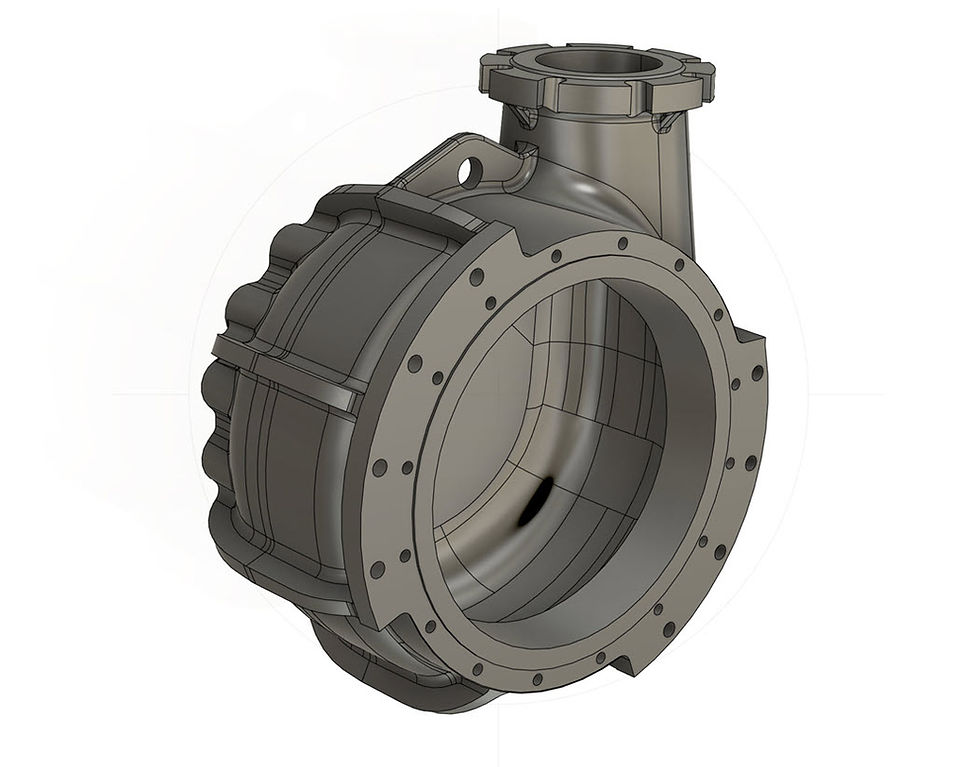
Scan Hub has completed many 3D laser scanning and CAD modelling projects for clients installing and maintaining pumps and impellers across Australia, in water treatment, mining sludge transfer and a wide range of industrial sites. Volute pump housings and impellers are among the most geometrically complex parts we capture, and getting them right requires high-precision scanning and real experience with organic, cast shapes.
This is a look at how 3D laser scanning and CAD modelling work on pump housings and impellers, why these parts are so hard to measure any other way, and how an accurate CAD model lets our clients redesign, assess and re-manufacture components with confidence.
Why Pump Housings and Impellers Are Hard to Measure
Volute-style pump housings and their impellers are defined by flowing, organic curves rather than simple flat faces and straight edges. The internal volute passage, the blade profiles on an impeller and the mating surfaces between components are almost impossible to measure accurately with traditional tools. Callipers and hand measurement cannot properly capture a curved, three-dimensional surface, and any error carries straight through to fit, performance and manufacturing.
These parts also demand precision. The curves and mating surfaces of a pump directly affect how it seals, how it performs hydraulically and whether a newly manufactured component will fit and function. That level of accuracy is exactly what 3D laser scanning is built for, and Scan Hub is very familiar with it.
Our Approach to Scanning Pumps and Impellers
Scan Hub has the technology and experience to scan these industrial items with precision up to +/- 0.02mm. This is close-range, metrology-grade scanning, a different level of accuracy from building or site capture, and it is what these cast and machined components require. We capture the full geometry of the housing and impeller, including the complex internal and blade surfaces that manual methods miss.
Our scan-to-BIM and CAD team uses state-of-the-art software designed to work directly with scan mesh and point cloud files, creating accurate digital twins of each component. From that data, we build a precise CAD model that reflects the real part, ready for engineering, redesign or manufacture.
A typical project runs like this:
1. Planning: we confirm the components, the surfaces and detail required, and the intended engineering use of the model.
3. Processing: the scan data is cleaned and registered into an accurate representation of each part.
4. CAD modelling: the data is converted into a precise, editable CAD model or digital twin.
5. Verification and delivery: the model is checked against the scan and delivered in the format your team and manufacturer need.
From Scan to New Component
The real value of this work is what the client can do with an accurate CAD model. With a precise model of the pump housing or impeller, our clients can make design changes and assess fluid dynamic properties, then send the CAD file directly to a manufacturer to cast and machine new components with high accuracy.
This matters most where original drawings no longer exist, or where a legacy pump needs replacement parts that are no longer available. Rather than reverse engineering by hand, the client works from a digital twin of the actual part. The whole process, from scan to new component, drastically reduces project risk and removes guesswork from re-manufacture.
What Clients Do With the Data
Accurate 3D data of pump housings and impellers supports a range of engineering and manufacturing work, including:
● Reverse engineering legacy pumps and impellers with no available drawings
● Redesigning components and assessing fluid dynamic performance
● Sending accurate CAD files to manufacturers for casting and machining
● Producing replacement parts that fit and perform correctly the first time
● Documenting existing components for maintenance and asset records
● Reducing project risk by working from the real part, not estimates
Frequently Asked Questions
How accurate is your pump and impeller scanning?
We scan pump housings and impellers with precision up to +/- 0.02mm. This is metrology-grade accuracy, suited to complex cast components where curves and mating surfaces must be captured exactly.
Why is 3D laser scanning better than manual measurement for pumps?
Volute housings and impellers are made of organic curves and complex surfaces that callipers and hand measurement cannot capture accurately. Scanning records the entire surface precisely, so nothing is missed or estimated.
Can you reverse engineer a pump with no drawings?
Yes. This is one of the most common reasons clients engage us. We scan the existing part and produce an accurate CAD model you can use to redesign or manufacture replacements, even when no original drawings exist.
Can the CAD model be used to manufacture new parts?
Yes. The CAD file we produce can be sent directly to a manufacturer to cast and machine new components with high accuracy, based on the real geometry of the original part.
Can the data be used to assess pump performance?
Yes. With an accurate model, engineers can make design changes and assess fluid dynamic properties before committing to manufacture.
What types of pumps do you scan?
We scan volute-style pump housings, impellers and associated components used in water treatment, mining sludge transfer and industrial applications across Australia.
What is a digital twin of a pump?
It is an accurate 3D digital model of the real component, built directly from scan data, that reflects the part's true geometry for engineering, redesign, and manufacture.
What deliverables do you provide?
We deliver high-accuracy point clouds, digital twins and precise CAD models in the formats your engineering team and manufacturer require.
How long does it take to scan a pump housing or impeller?
It depends on the size and complexity of the components and the accuracy required. We confirm timeframes before we start, based on your project.
Do you work on industrial pump projects Australia-wide?
Yes. We have completed pump and impeller scanning and CAD modelling projects for water treatment, mining and industrial clients across Australia.
Talk to Scan Hub About Your Pump Project
If you need to reverse engineer, redesign or re-manufacture a pump housing or impeller, an accurate scan and CAD model takes the guesswork out of the whole process. Scan Hub has the metrology-grade technology and experience to capture these complex components precisely. Contact us to discuss your project and get a fixed-price quote.